

Which Cabinet Material Is Best? MDF vs. Plywood vs. Solid Wood vs. Particle Board
When choosing for new kitchen cabinets, you may hear terms like solid wood, plywood, MDF, and particle board. But what do these materials actually mean? And which one is the best choice for your kitchen?
The answer is not as simple as choosing one material over another. Different materials have different strengths, and quality cabinets often combine several materials depending on where they are used.
In this blog, we’ll compare four common kitchen cabinet materials and explain their advantages, disadvantages, typical uses, and relative cost.
1. Solid Wood Cabinets
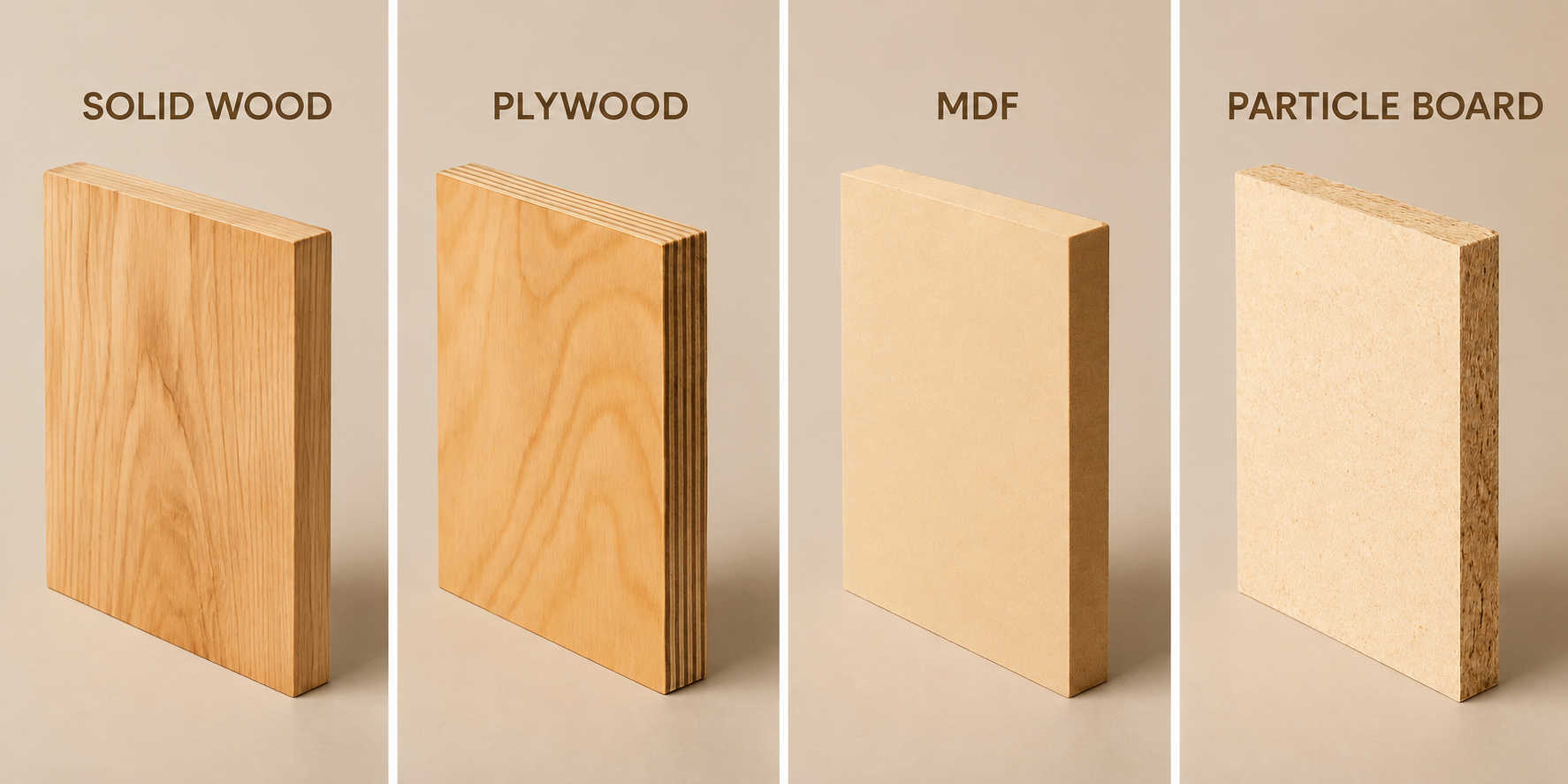
Solid wood is exactly what it sounds like: natural wood made from lumber rather than an engineered wood panel. It is commonly used for cabinet doors, face frames, mouldings, trim, and other visible components.
Advantages of Solid Wood
Natural wood grain and texture
Available in different wood species and finishes
Strong and durable when properly constructed
Provides a traditional, high-end appearance
Disadvantages of Solid Wood
Natural wood responds to changes in temperature and humidity. It can expand and contract as the environment changes, which is one reason proper installation and reasonable indoor humidity are important.
Solid wood is also generally more expensive than many engineered wood options.
Best Use
Solid wood is especially well suited for:
Cabinet doors
Face frames
Decorative trim
Kitchens where natural wood appearance is important
Cost: Higher
2. Plywood Cabinets
Plywood is an engineered wood product made from multiple thin layers of wood veneer glued together. The grain direction of adjacent layers is rotated, which gives plywood good strength and dimensional stability.
Plywood is commonly used for cabinet boxes, shelves, and other structural components.
Advantages of Plywood
Strong and rigid
Good dimensional stability
Good screw and hardware holding ability
Commonly used for cabinet boxes and shelves
Handles moisture better than MDF or particleboard in most applications, due to its cross-layered construction that resists swelling and delamination
Disadvantages of Plywood
Usually costs more than particleboard and many MDF applications
The appearance of plywood edges may require a veneer or other finished surface
Quality varies depending on the plywood grade and construction
Not waterproof – while it tolerates humidity better than other engineered panels, prolonged water exposure can still cause damage
Best Use
Plywood is particularly well suited for:
Cabinet boxes
Shelves
Structural components
Areas where strength and stability are important
Cost: Mid to higher
3. MDF Cabinets
MDF stands for Medium Density Fibreboard. It is made from fine wood fibers combined with adhesive and pressed into dense panels.
Compared with particleboard, MDF has a finer texture and is denser. It is commonly used for cabinet doors, shelves, and cabinet boxes.
One of MDF's biggest advantages is its smooth surface.
Advantages of MDF
Very smooth surface
Excellent for painted finishes
Consistent and uniform
Resists warping well
Generally more affordable than solid wood
Easy to machine into different door designs
Disadvantages of MDF
Does not have natural wood grain
Can be damaged by prolonged direct water exposure, especially at unsealed edges
Generally does not have the same natural appearance as solid wood
Heavier than some other panel materials
Important distinction: Standard MDF is vulnerable to moisture, but Moisture-Resistant MDF (MR-MDF) is available for kitchens and bathrooms. Even MR-MDF is not waterproof – proper sealing of edges and cutouts is still essential.
Best Use
MDF is especially popular for:
Painted cabinet doors
Smooth modern-style doors
Decorative panels
Budget-conscious cabinetry
For homeowners who want a clean, painted finish, MDF can be a very practical choice.
Cost: Mid to low
4. Particle Board Cabinets
Particle board is made from wood particles or chips that are bonded with resin and compressed into panels.
It is widely used in more economical cabinetry and can provide a cost-effective option when properly constructed and protected from moisture.
Advantages of Particle Board
Affordable
Consistent and uniform
Suitable for budget-conscious projects
Commonly used underneath laminate or other finished surfaces
Disadvantages of Particle Board
More vulnerable to moisture damage than plywood or MDF – water entering exposed edges or damaged surfaces can cause swelling and loss of structural integrity
Generally not as strong as higher-grade plywood for structural cabinet applications
Repairing damaged particleboard is difficult
Not recommended under sinks or dishwashers, where small leaks are most likely to occur
Best Use
Particle board can be suitable for:
Budget-friendly cabinets
Laminate or melamine cabinetry
Areas where keeping the overall cabinet cost lower is a priority
Important: If particle board is used, all edges must be properly sealed, and it should be kept away from high-moisture zones.
Cost: Lower
So, Which Cabinet Material Is Best?
There isn't one material that is automatically the best for every part of a kitchen.
Instead, think about where the material is being used and what you need it to do.
If natural wood appearance is important, solid wood is an excellent option for cabinet doors and visible components.
If strength and stability are priorities for the cabinet structure, plywood is a popular choice for cabinet boxes and shelves.
If you want a smooth painted finish, MDF can be a very practical choice – and for humid kitchens, consider Moisture-Resistant MDF.
And if keeping the project budget lower is the main priority, particle board can provide a cost-effective solution when properly constructed and protected from moisture.
In fact, many quality cabinets use a combination of materials, rather than using one material throughout the entire kitchen.
The Material Is Only Part of the Story
When comparing kitchen cabinets, don't look only at the material name.
Construction quality also matters.
Consider asking:
What material is used for the cabinet box?
What material is used for the doors?
How thick are the panels?
How are the cabinets assembled? (dowel, glue, dovetail, or cam lock?)
What type of drawer construction is used? (dovetail, glued, or stapled?)
What hardware is included? (soft-close hinges and slides?)
How are the cabinet edges finished? (edge-banded, veneered, or solid?)
What warranty is provided?
The same material can perform very differently depending on its quality, thickness, construction, hardware, and installation.
Final Thoughts
The best kitchen cabinet material depends on your budget, style, and how each part of the cabinet is constructed.
Solid wood, plywood, MDF, and particle board all have their place in kitchen cabinetry. Rather than simply asking, "Which material is the best?", a better question is:
"Which material is best for each part of my kitchen?"
In our next blog, we'll take this one step further and explain how to choose the right cabinet materials for your home, including what to look for in cabinet boxes, doors, durability, appearance, and overall value.
